Technologies We Work With
Advanced technology. Efficient cooling. Reliable performance
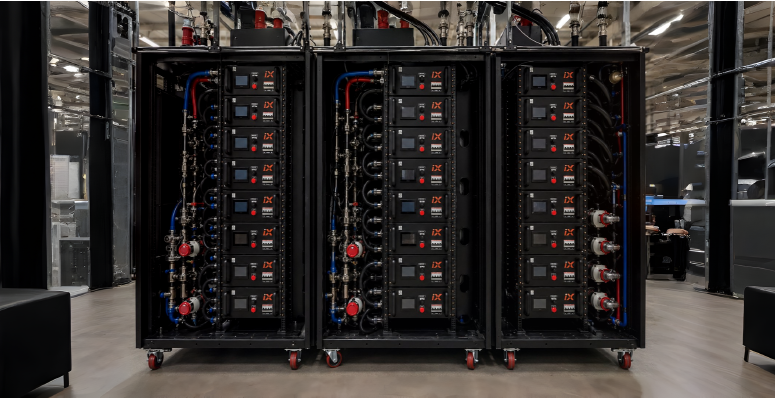
As computing density increases, traditional air cooling reaches its limits. We work with the most advanced liquid cooling technologies available — selecting and integrating the right approach for each environment, workload, and facility type.

Single Phase Direct‑to‑Chip Liquid Cooling
What it is
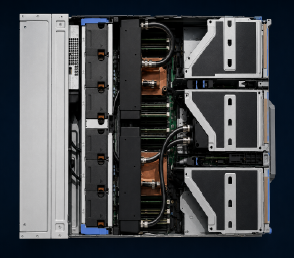
Single phase liquid cooling delivers coolant directly to a cold plate mounted on the processor or GPU — removing heat at the source before it ever enters the room. The coolant stays in its liquid state throughout the entire loop, making it the most straightforward liquid cooling approach to install, maintain, and scale.
How it works
Coolant flows from a Cooling Distribution Unit (CDU) through supply manifolds, into cold plates sitting directly on high‑heat components, and returns to the CDU to be cooled and recirculated. The rest of the server uses conventional airflow for lower‑heat components.
Best for
High‑density AI and GPU servers, HPC clusters, and data centers transitioning from air cooling who want a proven, low‑risk entry point into liquid cooling.
Key benefits
- Supports rack densities from 20kW up to 100kW+
- Lower PUE and energy costs vs. air cooling
- Compatible with standard rack infrastructure
- No phase change — simpler fluid management
- Can retrofit into existing data halls
Two Phase Direct-to-Chip Liquid Cooling
What it is
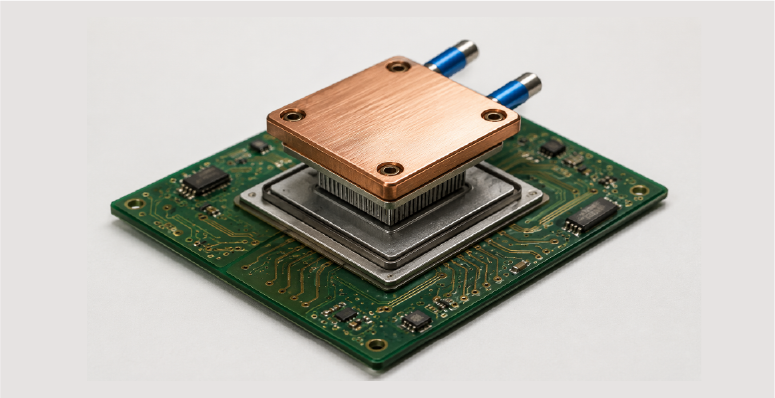
Two phase cooling takes direct-to-chip a step further. Instead of the coolant remaining liquid, it is deliberately allowed to boil at the cold plate surface — absorbing significantly more heat through the phase change from liquid to vapor. The vapor is then returned to the CDU where it condenses back to liquid and recirculates.
How it works
A specialized dielectric fluid flows to cold plates at the chip level. As it absorbs heat, it vaporizes. The vapor travels back through the return manifold to a condenser inside the CDU, where it returns to liquid form. This continuous phase-change cycle enables far higher heat flux at the component level than single phase.
Best for
Ultra-high-density AI training clusters, next-generation GPU systems, and research or HPC workloads where rack power density exceeds what single phase can efficiently handle.
Key benefits
- Handles extreme heat flux at the chip level
- Higher cooling efficiency than single phase
- Enables rack densities of 100kW and beyond
- Reduced coolant flow rates needed vs. single phase
- Future-proofed for next-generation compute hardware
Immersion Cooling
What it is
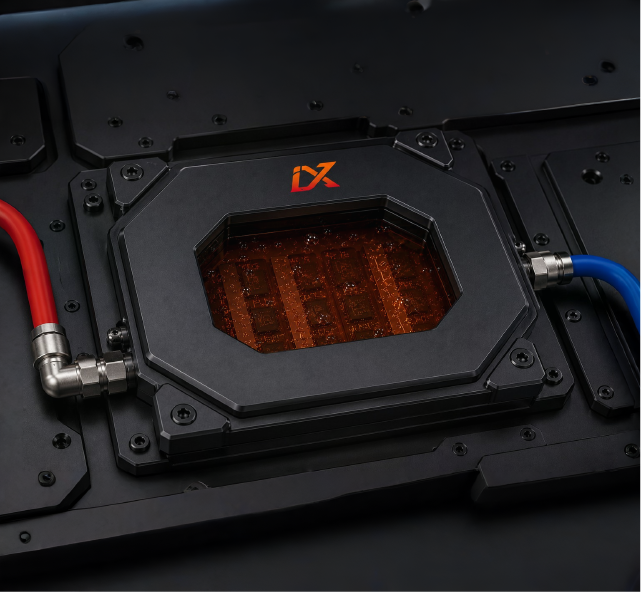
Immersion cooling submerges IT hardware — servers, GPUs, storage — directly into a bath of thermally conductive, electrically non‑conductive dielectric fluid. Heat is absorbed directly by the fluid surrounding the components, eliminating the need for fans, air handling, and traditional thermal management entirely.
Two types: Single phase immersion (fluid remains liquid) · Two phase immersion (fluid boils and condenses).
How it works
IT hardware is removed from standard rack enclosures and placed into purpose-built immersion tanks filled with dielectric fluid. The fluid absorbs heat directly from all components simultaneously. In single phase, the warm fluid is pumped to an external CDU or heat exchanger. In two phase, the vapor rises and condenses passively on a condenser coil above the fluid surface.
Best for
Maximum-density AI and HPC deployments, edge facilities with constrained space, cryptocurrency mining, and operators looking to eliminate cooling-related PUE overhead almost entirely.
Key benefits
- Highest possible cooling density — up to 200kW+ per tank
- Near-silent operation — no fans required
- PUE approaching 1.0 in optimized deployments
- Hardware runs cooler, extending component lifespan
- Removes heat-related failure as a reliability risk
- Waste heat can be captured and reused
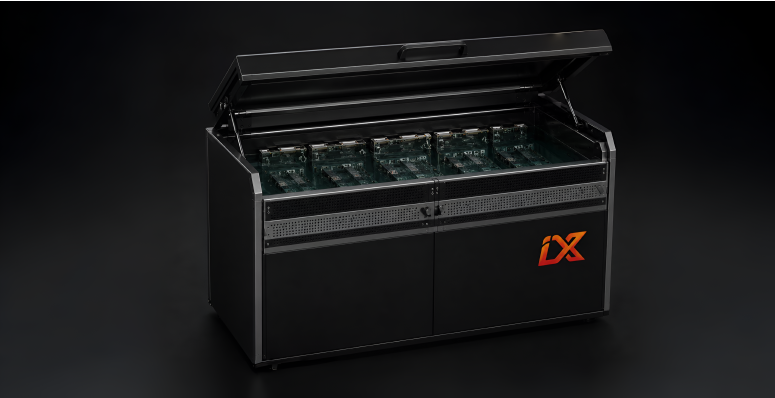
CDU & Manifold Systems
What it is
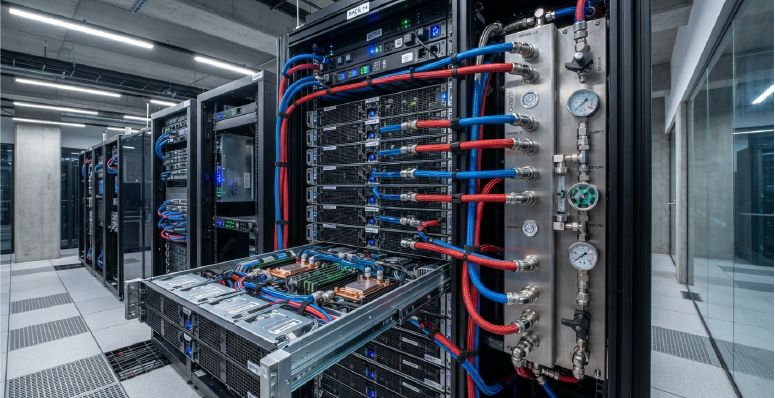
The Cooling Distribution Unit (CDU) is the heart of any liquid cooling system. It conditions, pumps, and controls coolant flow to and from the IT hardware. Manifolds distribute that coolant to individual cold plates or immersion loops at the rack level. Together, CDUs and manifolds form the hydraulic backbone that makes liquid cooling deployable at scale
How it works
The CDU connects to the facility water supply or a dry cooler on one side, and to the IT equipment via supply and return manifolds on the other. It manages coolant temperature, pressure, and flow rate — ensuring every cold plate or immersion loop receives the right conditions. Rack-level manifolds branch the flow across multiple servers within a single rack, with individual connections per server.
Best for
Any liquid cooling deployment — CDUs and manifolds are required infrastructure for direct-to-chip and immersion systems at rack or row level.
Key benefits
- Centralized control of coolant temperature and flow
- Supports multiple racks from a single CDU unit
- Leak detection and safety interlocks built in
- Scalable — add capacity by adding CDU units
- Compatible with facility chilled water or adiabatic cooling
- Monitoring and control integration via BMS or DCIM
Load Bank Testing
What it is
Load bank testing uses controlled electrical or thermal loads to simulate real-world demand on power and cooling infrastructure — without using live production hardware. It is the industry standard method for commissioning new facilities, validating backup power systems, and proving that cooling infrastructure performs as designed before critical workloads go live.
For liquid cooling environments, thermal load banks go further — physically emulating the heat output of high-density servers at the rack level, allowing CDUs, cold plates, manifolds, and fluid loops to be fully validated under realistic thermal conditions before any IT equipment arrives.
Two types we support:
- Electrical load banks — test generators, UPS systems, and backup power under real load conditions.
- Thermal / DCLC load banks — modular cartridge‑based units that emulate rack‑level heat loads up to 135kW.
How it works
The CDU connects to the facility water supply or a dry cooler on one side, and to the IT equipment via supply and return manifolds on the other. It manages coolant temperature, pressure, and flow rate — ensuring every cold plate or immersion loop receives the right conditions. Rack-level manifolds branch the flow across multiple servers within a single rack, with individual connections per server.
Best for
New facility commissioning, post-maintenance validation, AI/HPC infrastructure go-live readiness, and manufacturers who need to validate cooling system performance in a controlled environment
Key benefits
- Commission without risking live hardware
- Validates power and cooling systems under real-world load
- Identifies issues before go-live, not after
- Repeatable and programmable — run the same test multiple times
- Faster deployment timelines for AI and HPC facilities
- Full documentation and pass/fail reporting